
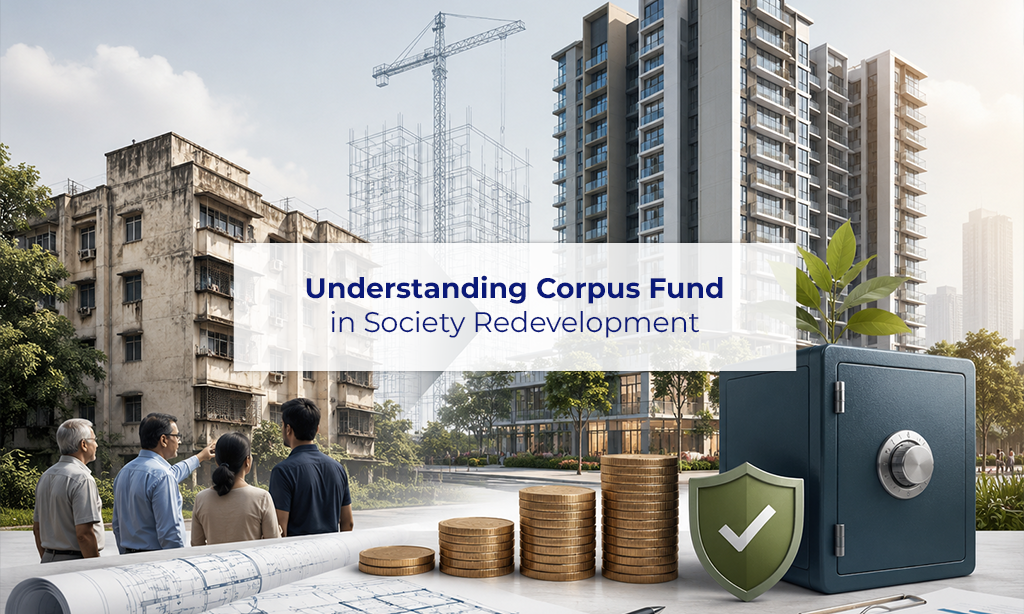
Knowing the initial cost of property alone is not enough to purchase a home or manage a residential estate. It involves several other financial components. One of these is the corpus fund in society. It secures the structural and operational longevity of the building. Before you give your society for redevelopment, it is crucial for every resident, real estate developer and housing society members to understand corpus fund meaning, its legalities, calculation formulas and implications.
What is corpus fund in real estate?
Corpus fund is a capital reserve collected from property buyers in order to secure the long-term financial health of a building. The term ‘corpus’ means the principal or core capital amount that is kept separate from standard operational funds so that it can be invested securely, allowing the housing society to use the generated interest only. This can be used for major, non-recurring capital expenses.
This initial corpus fund received from the builder is taxable or not when a project is developed depending on how it is structured upon handover to the RWA (resident welfare association) or CHS (co-operative housing society).
Corpus fund meaning in housing society
Corpus fund meaning within a housing society or building association indicates a permanent financial reserve that is made for asset preservation, representing a lump-sum payment made by individual flat owners, compiled together to create a financial bedrock.
Rather than collecting monthly maintenance dues from society members, this compiled capital is strictly reserved for structural upgrades and emergencies. This corpus fund for flats for sale also helps preserve the market value of the entire real estate project and prevents deterioration of shared amenities.
Importance of corpus fund in housing society
One of the key benefits of corpus funds is that it prohibits the devaluation of the property by ensuring that sufficient funds are available for preventing long-term decay due to emergency structural repairs.
Additionally, to make a property safe and structurally sound, with increased creditworthiness of the housing society, a well-managed reserve is a must, eliminating the need for ad-hoc financial contributions from residents, which often leads to internal disputes, delayed repairs, and legal stalemates within management committees.
How is corpus fund used in society?
The uses of corpus funds are managed by the society bylaws and real estate statutes to avoid misappropriation. The principal amount is usually put in low-risk, long-term capital investments, such as FDs in government or nationalised banks/securities.
Other uses of corpus fund include:
- Execution of major waterproofing of the building façade or structural repairs
- Replacement of capital-intensive machinery, like backup generators, heavy-duty water lifters, cranes, elevators, etc.
- Upgrading of electrical substations, firefighting equipment and sewage treatment plants
- Fund functional renovations, such as parapets, boundaries, exterior towers, etc.
Difference between corpus fund and maintenance fund
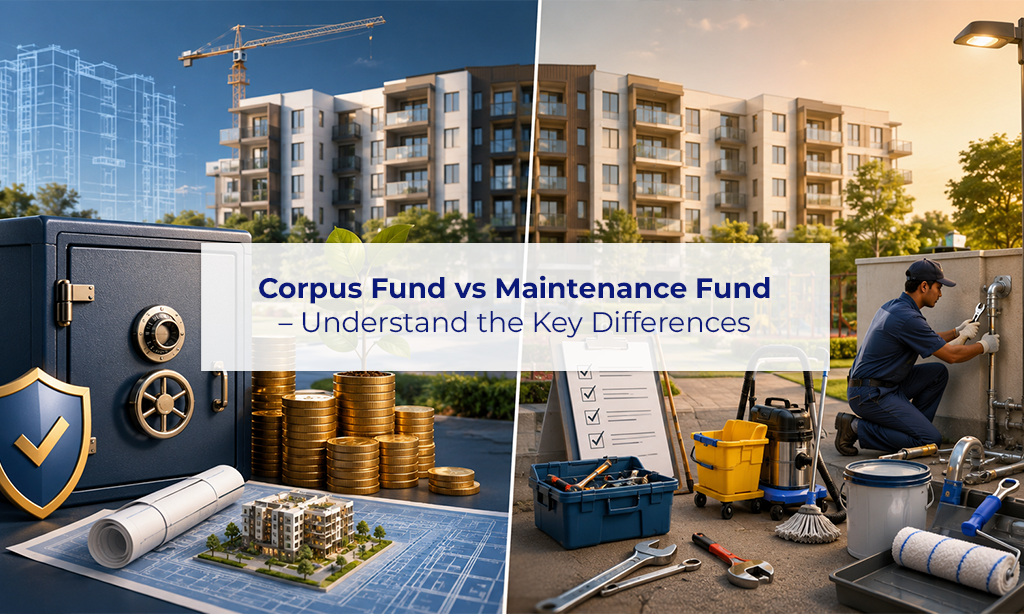
| Difference between corpus fund and maintenance fund | Corpus Fund of a Society | Maintenance Fund |
|---|---|---|
| Primary Purpose | Preserving long-term assets, replacing capital equipment, and structural repairs | Daily operational costs, routine repairs, and administrative expenses |
| Payment Frequency | One-time lump sum amount is paid during property possession or during a redevelopment phase | Recurring monthly, quarterly, or annual payments |
| Utilization Rules | Whatever interest is earned ideally; principal amount is used only under special approvals. | Fully consumed within the financial year to settle regular service bills. |
| Typical Cover | Lifts, structural waterproofing, transformers, firefighting systems, and core renovations. | Security personnel, housekeeping, common area lighting, minor plumbing, and water charges. |
| Refundability | Completely non-refundable; transfers automatically to the new buyer upon resale of property. | Non-refundable; consumed periodically for services utilised by the resident. |
How corpus fund is calculated in housing society?
In the Indian real estate market, the determination of corpus fund amount is not arbitrary. It follows a systematic financial structure to ensure equity among all flat owners based on their specific carpet areas or asset sizes.
Formula for calculating corpus
What is corpus fund in apartments is calculated by multiplying the built-up area of the individual apartment by a pre-fixed per-square-foot rate.
Individual Corpus Fund = Built-Up Area of Flat (sq. ft.) x Per Sq. Ft. Rate as fixed by Builder/Society
Total Housing Society Corpus Fund = ∑(Individual Corpus Fund of All Flats) + Accrued Interest
Practical Example of Corpus Fund Calculation in Apartments
For a clear understanding of what is corpus fund in apartments calculated, let’s consider a residential tower that has two types of configurations – 2 BHK units with a built-up area of 1000 sq. ft., and 3 BHK units with 1500 sq. ft.
If the developer or the initial general body fixes the capital reserve rate ₹50 per sq. ft., the financial distribution will be calculated as follows:
For a 2 BHK Flat: 1,000 sq. ft. x ₹50 = ₹50,000
For a 3 BHK Flat: 1,500 sq. ft. x ₹50 = ₹75,000
After collection from all 100 units in the complex, this aggregate amount forms the permanent capital reserve of the society.
Who decides the corpus fund amount in housing society?
In the initial phase, the real estate developer or promoter decides the corpus fund of society, which is clearly stated in the builder-buyer agreement.
Once the construction is completed and the developer transfers the property control, the newly formed managing committee, supported by the consensus of the general body of residents, holds the entire authority, from reassessment to additional collection, if needed.
Factors Affecting Corpus Fund Calculation
- Total amenities of the premium project. If multi-level parking, swimming pools or expansive landscaped zones are present, then a higher corpus fund of society is needed.
- Older society redevelopment/major repair cycles need higher reserves than brand new structures.
- Buildings located in high seismic zones or coastal regions face faster depreciation and need larger emergency funds.
- Quality of construction materials, such as grades of steel and concrete, requires major funds.
When is Corpus Fund Paid?
The payment window for the corpus fund for flats depends on the property type – fresh allocation or a redevelopment project. In standard direct purchases, the lump-sum amount is collected at the time of taking possession of the flat, right before the registration or handing over of keys. During the handover phase, the developer collects these funds.
Is Corpus Fund Refundable?
No, the corpus fund in apartments is strictly non-refundable. Even if the society member exits the housing society or sells their flat, they are not eligible for a refund. It automatically transfers to the new property owner.
Is Corpus Fund Mandatory?
Under most builder-buyer agreements and society bylaws, contributing to the capital reserve is mandatory for flat allottees. They cannot opt out of paying this corpus fund in apartments. TThe developer may withhold property possession if the designated corpus fund for flats is not received, depending on the terms of the agreement.
Corpus Fund Rules in Housing Society
Corpus fund rules in housing society are subject to strict regulatory compliance to avoid financial irregularities by internal members or external agencies. Basic rules include: upfront collection while booking or purchasing a flat, accurate calculation per society norms and strictly not include this as a substitute for maintenance fund.
Corpus fund rules under RERA Act
RERA promotes financial transparency in real estate projects, and developers are generally required to maintain project-related funds in designated bank accounts as per applicable regulations.
Also, the developer must transparently transfer the entire collected capital, along with complete audited bank statements, to the registered RWA or cooperative society within the applicable statutory timelines of its formation.shift cost escalation
If a developer fails to transfer these funds or utilises them for construction costs, they face severe financial penalties and legal prosecution under RERA sections.
A common point of confusion is: Is the corpus fund taxable or not? As per ITAT rules, the initial corpus fund collected or transferred to a society is treated as a capital receipt, not revenue income. Therefore, the core fund is non-taxable at the entry point. However, any subsequent interest income generated from investing this corpus in bank fixed deposits is completely taxable under “Income from Other Sources,” unless specific statutory tax exemptions apply to the society.
What is corpus fund in redevelopment?
Corpus fund in redevelopment is a substantial monetary compensation paid by a real estate developer to the existing members of a housing society undergoing reconstruction or demolition. Residents don’t need to pay any amount; the developer takes the load.
How is the corpus fund calculated in redevelopment?
The corpus fund calculation in redevelopment depends on commercial viability, additional Floor Space Index (FSI) availability, and hardship compensation.
Redevelopment corpus payout is generally calculated based on the existing carpet area, agreed premium rate per sq. ft., hardship allowance, and shift cost escalation.
What is the role of corpus funds in redevelopment agreements?
The legally binding tripartite or development agreement between society members, the managing committee and the builder must clearly state the norms in the corpus fund in redevelopment agreement, stating the timelines for the fund disbursement, like 10% at the signing of the agreement, 40% during construction stages and the remaining 50% at the time of offering new possession. It should also state that the corpus fund received from the builder is taxable only if it contains components that do not fall under the capital hardship compensation criteria.
Read more: Redevelopment Opportunities in Mira Road
Common Mistakes Homebuyers Make Regarding Corpus Fund
- Buyers miss out on taking the corpus fund certificate from the developer during handover. This is proof that you have successfully contributed to the corpus fund for your apartment.
- Homebuyers confuse capital reserves with advance maintenance. You must ensure to take separate receipts, categorised correctly.
- Buyers fail to cross-check the corpus fund apartment values and physical bank balances during the society handover phase. Both these values should be checked thoroughly.
- Some homebuyers do not understand the question: Is the corpus fund taxable or not? Buyers should track the tax liabilities on the interest generated by their corpus fund for society deposits.
FAQs
What is a corpus fund in a housing society?
Corpus fund of a society is a reserve amount collected from all individual flat owners of a project. It is invested and utilised for long-term repairs, infrastructure replacements or emergent property damages.
Can a housing society increase corpus fund after formation?
Yes, if the existing fund is deemed insufficient due to inflation, construction expansion or building degradation, the managing committee can propose a corpus fund increase only upon the formal resolution passed by a majority vote during AGM.
Who controls and manages the corpus fund after it is collected?
During the construction phase, the developer or builder holds the corpus fund in a separate escrow account. After completion and possession, it is handed over to the elected managing committee.
What mistakes should societies avoid while handling corpus fund?
Societies should not mix the maintenance amount with the corpus fund. They generally prefer low-risk investments for corpus funds rather than volatile investment instruments. They should also collect corpus fund certificates from all flat owners to maintain the records.
What is the use of corpus fund?
The use of corpus fund is generally reserved for non-routine capital expenditures, such as waterproofing structural overhauls, repainting exteriors, upgrading firefighting systems, installing new transformers, or completely replacing old elevators.
How is corpus fund calculated?
Corpus fund for apartment is calculated by multiplying the built-up area of the individual apartment by a predetermined per-square-foot rate set by the builder or the general assembly of the housing society.