
Even though India’s institutional inflows in the real estate sector have seen a rapid surge of USD 1.7 billion in 2026, the fundamental dilemma remains to find out the best between a retail shop vs office space for long-term asset appreciation. As per the recent database, corporate offices have captured ~45% of all incoming capital. This has been driven by 21.5 million square feet of Grade-A gross leasing.
If you are someone who is looking to fund a commercial real estate investment, then balance two forces – the reliable, multi-year compounding yields of corporate-backed workspace environments versus the agile, high-margin, revenue-sharing potential of premier physical retail.
This guide ‘Retail Shop vs Office Space: Which Commercial Investment Offers Better Returns?’ will help you choose correctly so that your capital aligns with multinational corporate expansion or booming urban discretionary spending.
What Is Commercial Office Space Investment?
When you purchase a physical apartment or property primarily for business operations, administrative functions, or corporate offices, it is called investing in commercial office space. While you choose between a retail shop vs office space, you need to check the financial performance throughout.
As per CBRE’s 2026 commercial real estate report, India’s office market has achieved record-breaking annual net absorption figures of 82.6 million square feet. This shows a steady demand for the rise of centralised office hubs despite global hybrid work shifts.
When you do a commercial real estate investment to acquire a stable corporate income, you must ensure timely rent rollups and professionally managed property environments.
Types of Commercial Office Space
| Property Type | Core Definition & Features | Primary Target Tenants | 2026 Market Dynamics & Yield Outlook | Lease Framework & Capex |
| Grade-A Office Spaces | Premium structures with top-tier aesthetics, high-speed digital infrastructure, and strict ESG/green certifications. | Global Capability Centres (GCCs), Fortune 500s, Top-tier BFSI & Tech giants. | GCCs accounted for a record 48% of total leasing in Q1 2026. Yields hold steady at 6.5%–7.5%. | Long-term (5–9 years). Institutional tenants absorb major fit-out and customisation costs. |
| Grade-B & C Spaces | Older or peripheral buildings with standard amenities and functional designs lack premium sustainability tech. | Small-to-Medium Enterprises (SMEs), local firms, cost-conscious back-offices. | Seeing a slight investor resurgence as affordable commodity options, but faces higher vacancy risks. Yields: 7%–8.5%. | Mid-term (2–5 years). Higher tenant turnover: the landlord often bears minor renovation expenses. |
| Flexible & Co-Working Spaces | Fully managed, plug-and-play spaces featuring agile layouts, shared conference rooms, and scalable seating. | Startups, scale-ups, and modern enterprises seeking decentralised hub-and-spoke models. | Increasingly used as a portfolio optimisation tool by large enterprises. Expanding rapidly into Tier-2 cities. | Highly agile (month-to-month or 1–2-year managed terms). Landlord or operator funds complete the Capex. |
Did you know? Per CBRE’s report, 79% of India’s office space market has leased certified green Grade-A assets. This prioritises supreme tenant profiles, premium infrastructure quality and high-grade technology integration.
Who Should Invest in Commercial Office Space?
An office building investment is most suitable for High-Net-Worth Individuals (HNIs), family offices, and institutional entities. Even for those who look for predictable capital appreciation alongside steady cash flows, investing in commercial office spaces can appeal to long-term lease commitments with predefined rental escalations. Additionally, this also serves as an excellent option for investors to list assets via real estate investment trusts (REITs).
Learn more: Best Commercial Property in Mira Road for Value Investment
What Is a Retail Shop Investment?
The primary focus of a rental property investment is to acquire consumer-facing physical storefronts, particularly for fashion, apparel or experiential entertainment sectors. These fronts can range from high-street shopping zones to large-scale destination malls. When you study a retail shop vs office space layout, you should notice that retail performance is intrinsically tied to consumer purchasing power and foot traffic rather than corporate hiring trends.
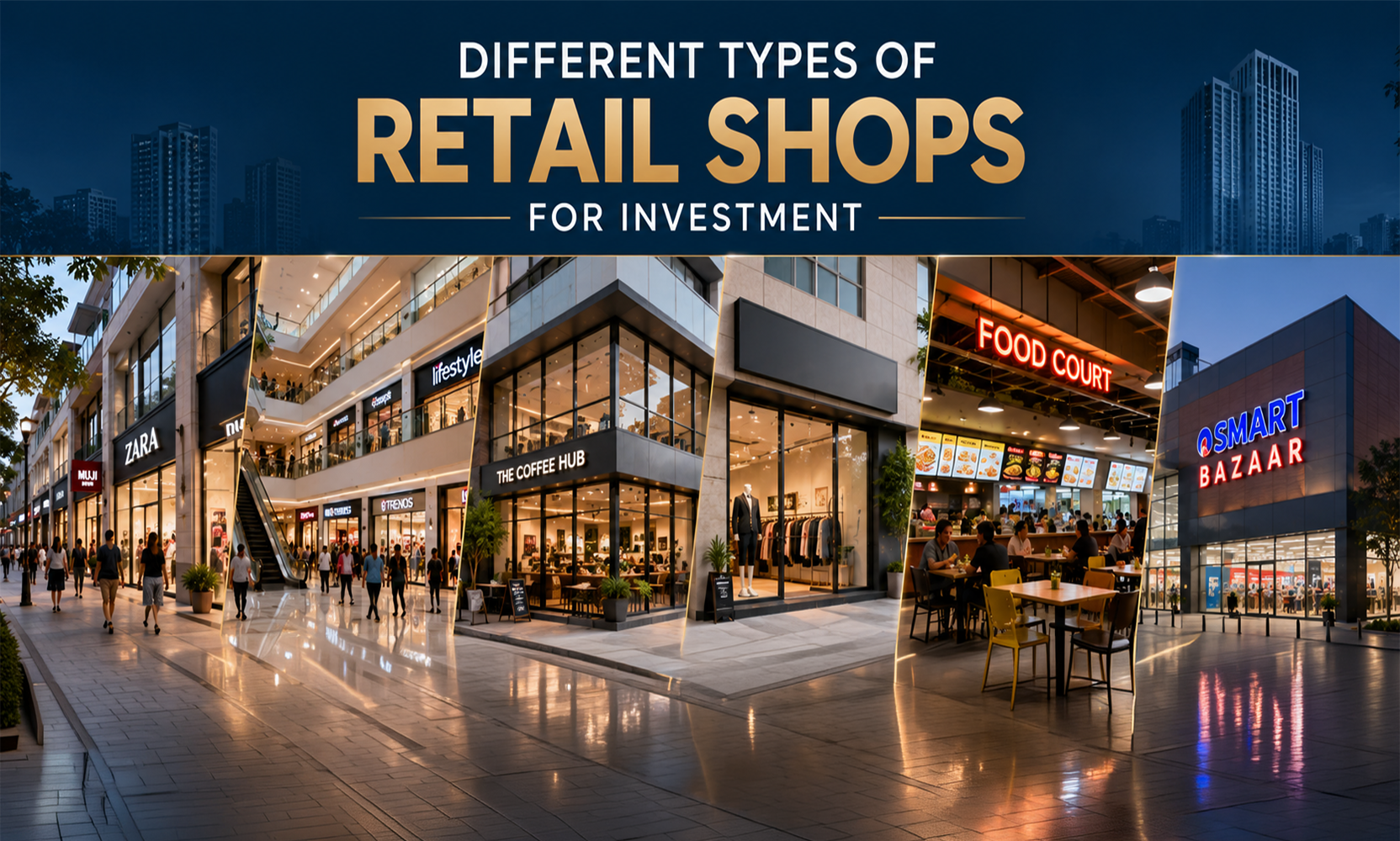
Types of Retail Shop Investments
| Investment Category | Core Layout & Footfall Source | Primary Target Tenants | 2026 Market Dynamics & Yield Outlook | Rent Structure & Risks |
| High Streets | Prominent, standalone open-air shopping corridors in historically premium commercial zones. | Luxury global brands, flagship fashion labels, high-end food & beverage. | Strong capital appreciation due to extreme land constraints. Yields range from 5% to 7% but offer incredible brand visibility. | Pure fixed base rent with high-margin escalations. High tenant retention but steep entry costs. |
| Destination Malls | Large-scale, enclosed shopping complexes (typically >800,000 sq. ft.) prioritising entertainment and dining. | Multi-brand anchors, multiplexes, fast-fashion chains, and D2C experience centres. | Dominating urban retail. Top-performing Tier-2 markets (e.g., Chandigarh) boast over 90% Grade-A mall stock with >90% occupancy. Yields: 7%–9%. | Hybrid model: Minimum guaranteed base rent plus a revenue-sharing percentage (typically 8%–15% of sales). |
| Neighbourhood & Transit Retail | Convenience-driven setups localised in housing societies or integrated into metro stations and airports. | Daily groceries, pharmacies, hyper-local salons, quick-service restaurants (QSRs). | Exceptionally resilient to e-commerce and economic downturns due to non-discretionary consumer needs. Yields: 6%–8%. | Highly stable, long-term local leases. Lower capital appreciation but minimal vacancy downtime. |
Who Should Invest in Retail Shops?
If your goal is to get higher agile rental yields with comfortable consumer market cycles, then investing in a physical retail space can help you leverage local market movements.
However, if you are choosing between office spaces and retail shops, the latter works best if you desire faster capital payback periods through timely 0/paid rents.
Fun fact: Per recent updates, Direct-to-Consumer brands drove 27% of recent leasing volumes by establishing physical stores to complement their digital operations.
Key Differences Between Retail Shop vs Office Space Investment
| Metric | Commercial Office Space | Retail Shop Investment |
| Average Rental Yield | Stable 6% to 7.5% annually | High-performing 5% to 9% annually |
| Lease Durations | Long-term 5 to 9 years | Agile 3 to 5 years |
| Rent Structure | Predefined fixed escalations | Base rent + Revenue-sharing models |
| Fit-Out Responsibilities | Handled completely by corporate tenants | Landlord-driven visibility / basic structural updates |
Risks: Retail Shop vs Office Space Investment
If you think buying a real estate property is completely risk-free and will give you 100% safe ROI for the future, then you should know that no asset class is completely devoid of downsides. And when you compare a retail shop vs office space risk, you must go through corporate macro-trends against shifting consumer habits.
Office spaces are vulnerable to systemic corporate layout adjustments, regional tech sector consolidations, and micro-market oversupply.
On the other hand, retail properties are directly exposed to consumer discretionary spending dips, hyper-local competition, and sudden changes in neighbourhood demographics.
Risks of Investing in Commercial Office Space
For a commercial office space risk, the major issue could be vacancy downtime. When a major MNC brand shifts its office premises, finding a replacement can take months. During this phase, office space rental costs and maintenance fees fall entirely on the landlord.
Secondly, if the investment has been done on an old property, then structural capital expenditures could increase the risks and make the asset obsolete.
Risks of Investing in Retail Shops
In the era where e-commerce platforms and quick-commerce channels are rushing, physical retail shops are trying to match their pace. Your rented small business real estate might face unstable cash flows. This can lead to sudden lease terminations and high tenant turnover.
Moreover, an old infrastructure or shop may lose its essence if a new construction or shop is launched nearby. This can abruptly divert the footfall, which can hinder your profit numbers.
Know more: How to Choose the Best Commercial Projects in Mumbai
Tax Benefits of Investing in Commercial Property
As a commercial property owner, you can get tax benefits. You get a 30% standard deduction on rental income for repairs and annual upkeep.
Furthermore, if your commercial property is acquired via debt financing, the interest paid on commercial real estate loans can be fully written off against the rental profits generated.
Tax Benefits of Investing in a Retail Shop
As a retail property owner, you can take advantage of tax returns. Legally, capital allowances permit landlords to depreciate internal property components, such as high-end air conditioning units, security installations, and bespoke structural facades.
Additionally, if any direct capital losses come from tenant fit-out adjustments or property modifications, then these can often be optimised through careful accounting.
Checklist before buying commercial property
Before you sign any commercial property investment papers or finalise office space for rent, you should cross-verify each and every clause stated in the contract.
- Check RERA registration status, clear title deeds, and up-to-date Occupancy Certificates (OC).
- You must assess public transit accessibility, macro-market vacancy metrics, and localised infrastructure pipelines.
- Do not miss out on examining lock-in periods, clear escalation percentages, and exact CAM (Common Area Maintenance) terms.
Retail Shop vs Office Space Investment in Mumbai
To choose between a retail shop vs office space asset for your long-term investment, you should do market research thoroughly. The growing demand for commercial property in suburbs, like Mira Road and the expansive MMR region, has led to Mumbai having India’s highest average office rental rates at INR 148 per square foot monthly. Also, Mumbai’s commercial office yields hold steady between 6% and 7.5%, whereas retail shop yields in Mumbai average 5% to 7%.
How to find the right retail shop or commercial office space in Mumbai
- Firstly, you need to decide early whether you want high-velocity retail returns or steady corporate payouts. Then you must settle the Retail Shop vs Office Space dilemma. It means you need to match your cash flow targets with the localised market yield profiles.
- For an institutional commercial office space, you have to prioritise active hubs like Mira Road, Powai, Andheri-Kurla, or the Thane-Belapur corridor, which lead the city in Grade-A office absorption. If you are on a hunt for a retail space, focus on suburban Grade-A+ lifestyle centres or established high streets where retail vacancies have tightened to an optimal 3.7%.
- Next, you need to invest in an area that lies in the expanding multi-nodal transport corridors, like the Western Express Highway, etc. Properties aligned with Metro Line 9 or 2B, the Coastal Road, or the Trans Harbour Link command premium office space rental costs and shield your property from unexpected vacancy downturns.
- Most importantly, you have to validate MahaRERA registrations, clear title deeds, and clear Occupancy Certificates (OC). To protect your commercial real estate investment against legal bottlenecks is in your hands only. So, do not hesitate to check all the clauses before making the final decision.
FAQs
What is the main difference between retail space and office space?
The main difference is their operational ecosystem and target audience. Retail properties encircle external consumer footfall, aesthetic visibility, and public accessibility to drive business sales. On the other hand, office properties rely entirely on corporate employment, workplace density, and regional business operations.
Which gives better returns in India: a retail shop or commercial office space?
You can maximise benefits via both. If your investment strategy is solid, then retail shops can provide faster capital payback windows and high performance. However, corporate workspaces offer far more predictable, multi-year compounding growth backed by institutional covenants. For well-located Grade-A assets across India, the overall commercial real estate returns blend both annual lease yields and steady capital appreciation to deliver total annual gains of 13% to 18%
What is the average rental yield for retail shops vs office space in India?
You can expect 5-9%* of rental yield for dominant destination malls or storefronts in prominent high streets. Meanwhile, institutional-grade workplace assets will give you a consistent 6-8%* return, which will be tightly secured by corporate lease agreements that include inflation-indexed rent escalation clauses every three years.
Which cities offer the best commercial property investment returns in India?
Mumbai offers the best commercial property investment returns. The growing suburbs, like Mira Road and Mumbai Metropolitan Region’s heavy infrastructure and booming tech-driven micro-markets, are consistently inviting real estate commercial investors for both retail shops and office spaces
Is commercial office space a good investment in 2026?
Yes, commercial office space demand has increased significantly over the last few years. Driven by massive gross leasing volumes crossing 21 million square feet, most MNCs and flexible workspace operators favour green-certified, sustainable structures, which is leading to a rise in demand for such commercial properties.
Is investing in a retail shop riskier than investing in office space?
Yes, your retail property investment might be slightly riskier than your office space investment, as the former carries higher operational volatility. The ROI can boom for your retail shop if your shop space is located at a prime spot and is not susceptible to changing e-commerce or consumer habits. For better guidance, connect with AsmitA India Realty today!