
Redevelopment of Housing Societies in Maharashtra: Complete Guide for Society Members
- AsmitA India Realty
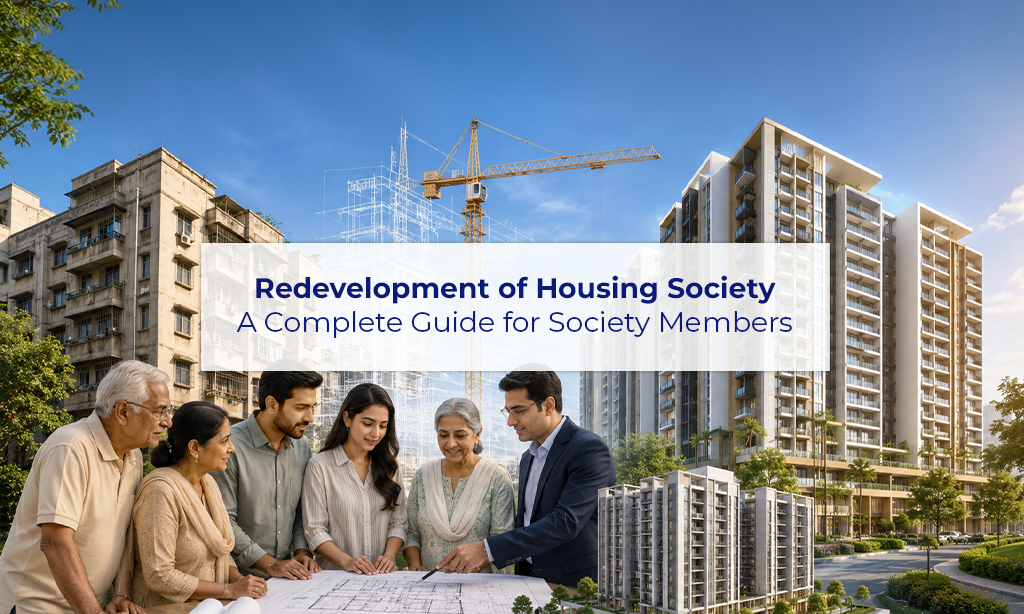
Surviving in the ageing residential complexes in Maharashtra has become stressful today. This has led to over 1000 redevelopment of housing societies’ agreements, paving the way for approx 60,000 new homes worth ~2 lakh crore and ~500 acres of surplus land.
Fortunately, the newly cleared 2026 Maharashtra Co-operative Societies Rules offer unprecedented protection. By standardising Section 79A rules, introducing flexible borrowing limits, and pushing for transparent self-redevelopment, the state has given power back to the people. Here is your definitive, up-to-date guide to executing a smooth, profitable, and secure redevelopment of a housing society project.
What is the Redevelopment of Housing Societies?
When we say redevelopment of housing society, it refers to the thorough process of reconstructing a building, demolishing the existing aged structure and replacing it with a modern one. The new structure is beneficial for the society members as it leverages the unutilised development potential of the land, commonly known as the floor space index (FSI). Through the process of entire building redevelopment, a licensed builder or the society makes the most of this additional FSI to construct extra floors, which may or may not include larger carpet areas, modern amenities and hi-tech infrastructural frameworks.
Why is redevelopment important in Maharashtra?
Many regions of Mumbai, like Thane, Mumbai Central, and the wider Mumbai Metropolitan Region (MMR), have become densely populated urban clusters, leading to land scarcity issues. Over 25000 buildings in the MMR region alone are over 35-55 years old and structurally not sound. These also require urgent urban renewal.
Redevelopment in Maharashtra supports this urban renewal. With thousands of cooperative housing structures in bad condition due to ageing or dynamic weather conditions, redevelopment allows these buildings to breathe new life into urban lifestyles. The entire process allows existing residents to live in their homeplace and also makes the area more prime without risking safety in dilapidated structures. The redevelopment in Maharashtra process also increases the city’s housing inventory.
Difference between Renovation and Redevelopment
Many society committees struggle to decide after how many years a building should go for redevelopment. Hence, understanding the key differences between structural repairs/renovation and redevelopment is crucial. Usually, the best practice is to audit the building and determine its viability if it has crossed 30 years of its life.
| Feature | Renovation / Structural Repairs | Redevelopment |
| Scope of Work | Cosmetic fixes, waterproofing, and minor structural strengthening. | Complete demolition and 100% new construction from the foundation up. |
| FSI Utilisation | No change in the existing utilised floor space. | Maximises available structural FSI, adding extra floors and areas. |
| Cost & Benefit | Borne entirely by members; no additional space is granted. | Funded by a developer, members receive larger flats and a corpus fund in redevelopment. |
Why is Redevelopment Necessary for Housing Societies?
Gone are the days when the redevelopment of housing societies used to be counted as luxury. It has now become a structural necessity. As the civic infrastructure goes through wear and tear due to rough weather conditions and other massive overhauls, ageing independent societies must go for redevelopment to avoid further failures and severe lifestyle depreciation.
Additional Carpet Area for Members
The primary benefit that societies experience during the society redevelopment in Maharashtra is the substantial increase in usable space. Under the current Development Control and Promotion Regulations (DCPR 2034), societies receive additional fungible compensatory FSI. This allows developers to offer existing flat owners an additional carpet area, which is approx 15-30% more than their present apartment size. The extended area is completely free of cost.
Increased Property Value
Outdated structures with leaking or damaged pipelines, no elevators, or peeling plaster lose value in the real estate market. These are not structurally safe either. The redevelopment of the cooperative housing society takes ownership to transform this old asset into a premium, earthquake-resistant high-rise tower, as approved by society members and RERA. The capital value of individual flats grows abruptly and instantly upon completion. Furthermore, families of the societies can enjoy modern upgrades such as:
- Automated tower parking systems
- Advanced fire-fighting infrastructure
- High-speed elevators and dedicated power backups
- Sustainable features like rainwater harvesting and solar grids
Know more: Mira Road Real Estate: Is It the Best Place to Invest in Property in Mumbai?
Latest Redevelopment Rules for Housing Societies in Maharashtra 2026
The entire legal process of the redevelopment of housing societies in Maharashtra adheres strictly to the rules and regulations. As of April 2026, the complete framework is regulated under the firmly enforced Section 79A of the Maharashtra Co-operative Societies (MCS) Act, 1960, preventing arbitrary builder practices.
Role of the Society and Government Approvals
No independent or unilateral decisions can be taken by the managing committee. It acts purely as an executing body. Under the revised redevelopment rules, the society must mandate video recording for all Special General Meetings (SGMs). Local municipal corporations in Maharashtra, such as the BMC, TMC, and PMC, have integrated digital single-window approval portals to speed up the issuance of the Intimation of Disapproval (IOD) and Commencement Certificate (CC).
The Redevelopment Agreement and GST Impact
Execution and registration of a detailed, legally binding development agreement should be done. This agreement covers exact project timelines, penalty clauses for delays, and specific bank guarantees.
The managing committee usually does not understand the GST on redevelopment of society building structures. Under the latest and updated GST guidelines, the constructive services provided by a developer to existing members for their alternative apartments (in lieu of their old flats) attract a 0% effective GST rate, provided it is a pure replacement.
However, any additional carpet area purchased by the member over their eligible allotment is subject to a 5% GST for standard housing or 1% for affordable housing, with no Input Tax Credit (ITC) available to the builder.
What is the Minimum Consent Required for Redevelopment
According to the updated society redevelopment rules, the government has permanently lowered the consent barrier to remove unwanted project deadlocks.
A minimum of 51% written consent of the total registered society members is required to officially greenlight a redevelopment plan and select a developer. This is a significant reduction from the historical 70% threshold.
Special General Meeting voting must be recorded via individual written affidavits during a formal SGM overseen by an authorised representative from the Co-operative Registrar’s office. Once 51% consent is achieved, dissenting minority members cannot legally stall the project.
Key Documents Required for Redevelopment
The list of documents for redevelopment is exhaustive. Hence, societies must compile all essential documents before inviting tenders. If any of these documents are missing, the entire process can lead to legal delays.
- A registered conveyance deed is needed as proof of land ownership in the society’s name. If this is missing, the society must obtain a deemed conveyance.
- Property Card & 7/12 Extract are next. This should be updated within the last 30 days and must show clear mutations.
- The original approved structural building plan & IOD.
- A structural audit report is mandatory for structures older than 30 years. This is issued by a certified structural engineer.
- A technical blueprint, called a feasibility report, is needed, detailing the plot’s total development potential.
Step-by-Step Process for Society Redevelopment in Maharashtra
Going through a step-wise society redevelopment process ensures full legal compliance and prevents future litigation. Maharashtra’s 79A guidelines for redevelopment of cooperative housing society units have laid down a mandatory sequence that must be followed by the societies and the developer:
- The legal process begins with a structural audit. The building’s health is checked and confirmed as to whether it is eligible for demolition or not.
- Post this, the committee issues a 14-day notice to call an SGM, where a formal resolution is approved by a majority to initiate the redevelopment process.
- Further, the society selects an independent Project Management Consultant (PMC) to look after technical aspects.
- The role of PMC is to draft a detailed feasibility report for the redevelopment of housing society plots to analyse FSI, TDR options, and commercial viability.
- Bidding and tendering then start. Public tenders are rolled out. These are analysed based on track record, financial stability, and what is corpus fund in redevelopment evaluation.
- After this, the society executes the master development agreement. On the other hand, the individual members sign the Permanent Alternate Accommodation Agreement (PAAA).
- The last step for this process is that before starting any marketing or construction activity, the chosen builder registers the project under MahaRERA. Failure to do so will lead to strict legal actions or penalties.
Common Reasons Redevelopment Projects Get Delayed
Even though the redevelopment rules are clearly stated, most of the redevelopment projects face delays due to minor mistakes. One of the causes is title defects, such as a missing conveyance deed, which halts municipal building approvals.
Secondly, internal disputes within the managing committee over tender and bidding selections can delay the redevelopment project’s progress for months. In addition, developers who take on excessive leverage may face financial difficulties. This highlights the importance of verifying a 20% bank guarantee. Finally, if the project fails to secure timely environmental clearances or RERA registration timelines, construction starts can be delayed.
Self-Redevelopment in Maharashtra
Self-redevelopment is widely increasing as an alternative to traditional builder-led protocols. Under this criterion, the housing society removes the middleman completely. They then choose to execute the project on their own.
The self-redevelopment process requires society to take charge of the entire operation. Architects, project management consultants, and contractors are hired by the managing committee itself. Rather than relying on the developer’s capital, the society secures specialised, low-interest project loans from financial institutions, like Maharashtra State Co-operative Bank.
While the self-redevelopment process requires significant effort, time, administrative responsibilities and active participation of society members, the financial returns are much higher. All profits generated from selling the surplus apartments directly go into the society’s account. This allows members to secure larger flats and a bigger corpus fund.
How to Choose the Right Developer for Redevelopment
The most critical decision is to select the right developer for the redevelopment of cooperative housing society projects. If wrongly selected, the choice can lead to delayed or overestimated project costs and legal complications. Here’s a checklist adhering to the redevelopment rules that societies can follow:
- Firstly, check the developer’s creditworthiness, net worth and financial statements. Society must ensure that they provide a 20% bank guarantee on the entire project cost.
- Secondly, the managing committee must inspect past redevelopment projects completed by the developer. The committee can enquire about the past projects to evaluate the construction quality and timeline adherence.
- Thirdly and most importantly, ensure that the developer has a MahaRERA verification and a clean record on the MahaRERA portal. Also, check for no ongoing major litigation, systemic project delays or structural default judgments.
- Lastly, the developer’s team should have experienced structural engineers and modern construction technologies to ensure timely completion of the redevelopment project.
For further assistance on redevelopment, contact Mira Road’s top developer, AsmitA India Realty.
Understanding Redevelopment Costs and Compensation
While going through the process of redevelopment, the society members must closely scan through the commercial terms of the proposal. A successful project should provide financial security alongside a new home.
The transit rent should be finalised. The developer must pay for members’ temporary housing during construction. This rent should match the existing local market rates and include a mandatory 5% to 10% annual escalation clause in case timelines stretch out. Additionally, the brokerage and shifting charges should be clearly stated. The builder should provide a lump-sum payment to cover moving expenses both out of and back into the redeveloped property.
Many societies ignore the corpus fund. This is crucial as societies must clearly understand what is corpus fund in redevelopment terms. The corpus fund in redevelopment is a capital reserve paid by the developer to the housing society. This lump-sum fund is invested in safe, long-term instruments to generate interest, which helps offset the higher property taxes and maintenance costs typical of new luxury high-rises. Members must ensure the exact timeline for corpus distribution is clearly locked down in the Development Agreement, with a significant portion paid before they hand over their keys for demolition.
Learn more: What is Corpus Fund? Meaning, Charges & Rules in Real Estate
Future of Redevelopment in Maharashtra and the MMR Region
With stricter MahaRERA monitoring, standardised Section 79A guidelines, and rising interest in community-driven self-redevelopment, the real estate market and the landscape of housing society redevelopment across urban areas in Maharashtra are becoming safer and more reliable for society members.
A key example of this regulatory evolution can be seen in the New MBMC rules for redevelopment within the Mira Bhayandar Municipal Corporation area. To address its rapidly growing population, the MBMC has introduced relaxed road-width parameters and rationalised premium charges for transit FSI. This makes previously unviable, smaller plots highly attractive for structural redevelopment.
FAQS
What is PAAA agreement in redevelopment?
The PAAA (Permanent Alternate Accommodation Agreement) is a legally binding contract executed individually between each member and the developer during the redevelopment of housing society projects. It guarantees your specific new flat number, additional carpet area, transit rent, and corpus amount.
What happens if a member refuses redevelopment?
If a member refuses, the managing committee can take legal action under Section 91 of the MCS Act. Once 51% of members give consent, the remaining minority must comply with the society redevelopment rules. The society can approach the Cooperative Court or High Court to evict dissenting members to ensure the redevelopment of the housing society asset proceeds smoothly.
Is redevelopment profitable for society members?
Yes, the redevelopment of housing society properties is highly profitable. Members receive a modern, earthquake-resistant home with an additional 15% to 35% carpet area completely free of cost. Furthermore, developers provide a hefty corpus fund in redevelopment projects to cover future maintenance, alongside a massive spike in the overall property valuation.
Can a society go for self-redevelopment in Maharashtra?
Absolutely. A housing society can reject external developers and choose self-redevelopment to retain full project control. In this model, the society retains 100% of the surplus FSI profits instead of sharing them with a builder. The government supports this choice with specialised low-interest loans, reduced premium charges, and expedited fast-track municipal approvals.
Who pays for the redevelopment of the housing society?
In a standard redevelopment of a housing society model, the selected private developer funds the entire project, including construction, municipal premiums, transit rent, and moving costs. The builder recovers these massive expenses and generates profits by constructing and selling additional commercial or residential apartments created through the unutilized FSI available on the plot.
Can one member oppose redevelopment?
No, an individual member cannot stop the redevelopment of housing society plans if the majority agrees. Current state guidelines dictate that a single dissenting individual cannot block the collective will of the community. Once 51% of the members pass a resolution, the project legally advances under the official redevelopment rules enforced in Maharashtra.
Table of Contents

Latest Blogs
Hot Property